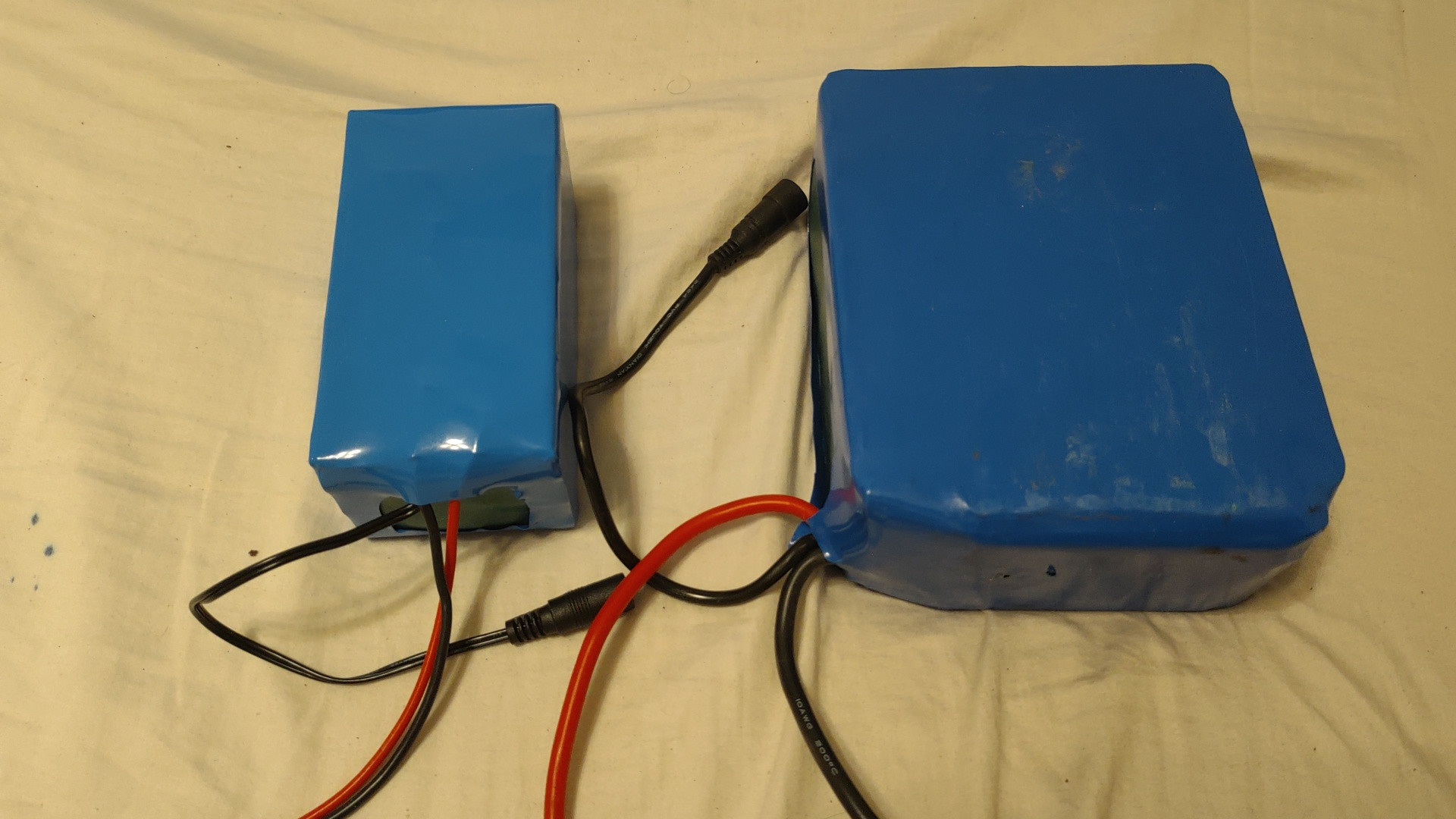
In general, that is not necessarily true unless the size of the battery packs are also different. For example, let assume there are ten 3.6V nominal Li-ion cells. With those, one can build either a 36V battery pack or a 18V battery pack when using all cells. And while the 36V pack will have twice the voltage, the 18V pack should be able to supply twice the current -- and power = voltage * current in this case.
Now, if one makes battery packs with 8 batteries and 12 batteries using the same cells, then obviously the latter one can provide 50% more power, but it will also be about 50% heavier and bigger.
For kicks, I measured 3 power tool battery packs, shown with their official specs:
18V 1500 mAh NiCd: weight: 783g, no-load out: 19.9V (no usage since charging it a few days ago)
20V 1.5 Ah Li-ion: weight: 373g, no-load output: 20,0V (some usage after charging a few days ago)
20V 5 Ah Li-ion: weight: 676g, no load output: 20.5V (no usage since charging it a few days ago)
The above Li-on packs most likely contain 6 or some multiple of 6 LFP (Lithium Iron Phosphate) cells.
The NiCd pack probably contains 16 cells, and not only it's a bit heavier, but it is also a bit larger than the 5 Ah Li-on pack.