I didn’t read this section before posting the above, but it shows that I was right about the importance of group delay and impulse response.
from the audioXpress link:
Regarding these alignments, I once attended a practical demonstration by Ulrik Schmidt, who worked at Scan-Speak at the time (now with Danesian Audio/SB Acoustics), and while I was working at Dynaudio, around 2001. It was a presentation for the Danish Electroacoustic Fellowship (DEF) and there were many people in the room. Ulrik had designed three boxes, each made with a similar driver but tweaked for different Qt values, so that he could align them exactly with a C4 alignment, a Chebyshev alignment; the B4, which is this discrete alignment where we need a very specific Qt; and the Bessel alignment.
With this demonstration, we could clearly hear the difference in sound quality. It became immediately apparent that the C4 alignment sounds “dark” and “dull” and lacks detail, whereas the Bessel alignment has the best bass performance of the three. It doesn’t go the deepest, but it sounds the best, it’s very impulsive and musical sounding. So, thank you Ulrik for that one - it was a great demonstration!
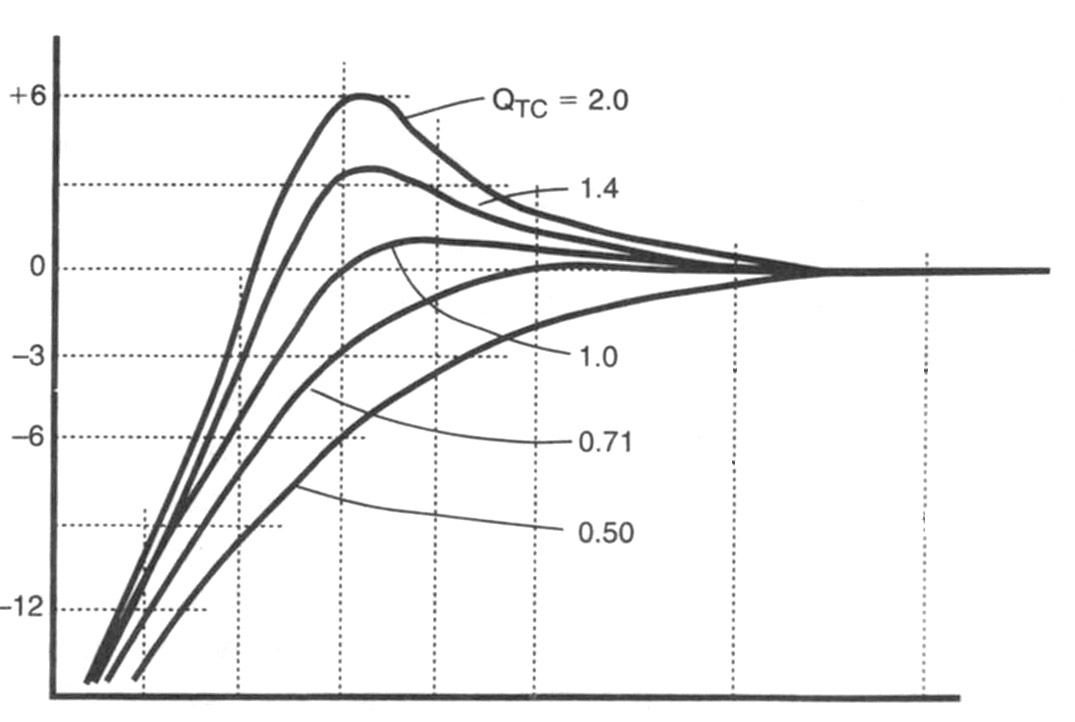
However, the majority of retail closed boxes are tuned probably to the range of 0.7 - 1.5 or so because of the significantly extended low frequency response.
Could not find any response curve on the web that I would consider fully accurate ( 🙁 ), but this (I’d say 66% accurate) curve should show why speakers are often aligned to a Qtc of around 1 or so.
Edit:
This is not a Qtc curve per say. but this is how it should look like:
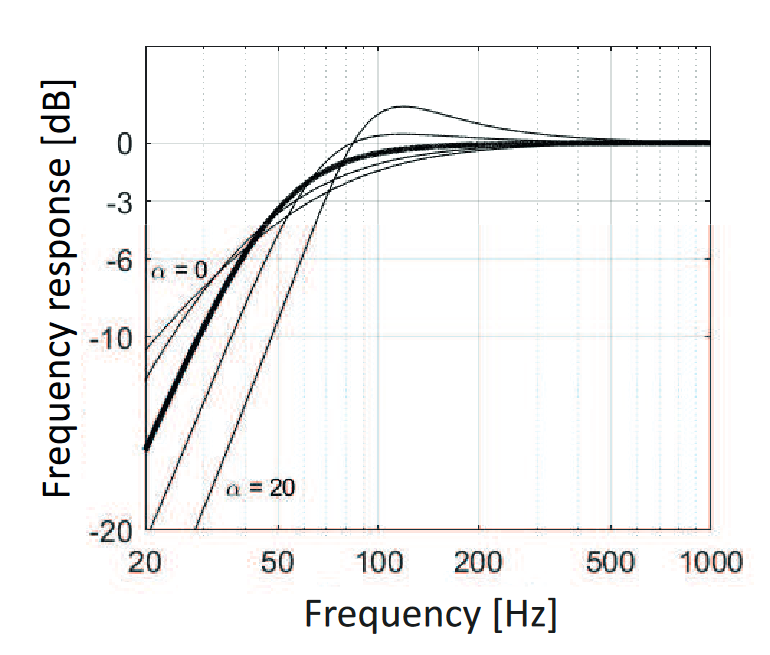
Source: https://riunet.upv.es/bitstream/handle/10251/134114/Castells%20-%20Design%20of%20loudspeaker%20enclosures%3A%20closed%20box.pdf?sequence=1