It can be really helpful if you actually read and understand what’s in a posted link. 😉
First and foremost, that wikipedia link contains this:
Most staple food grains, like wheat, rice, soybean, maize and sorghum, need no insect help at all; they are wind or self-pollinated. Other staple food crops, like bananas and plantains, are propagated from cuttings, and produce fruit without pollination (parthenocarpy). Further, foods such as root vegetables and leafy vegetables will produce a useful food crop without pollination, though pollination may be required for the purpose of seed production or breeding.
Not sure if you familiar with potato farming – no seeds or pollinators are necessary, unless you’re creating hybrids. (I planted and harvested potatoes on my grandparents’ farm)
Second, that table has a column labeled “Pollinator Impact” with values of : 4-essential, 3-great, 2-modest, 1-little. Potatoes in particular in the “1-little” category since seeds aren’t necessary for planting and propagation.
The majority of staple food items are either grasses or tubers, and they do not need pollinators, although in some cases (i.e. soybean) pollinators can increase the yield by 10 - 25%.
Here is a chart with the top 10 staple foods, and none of them necessarily require a pollinator.
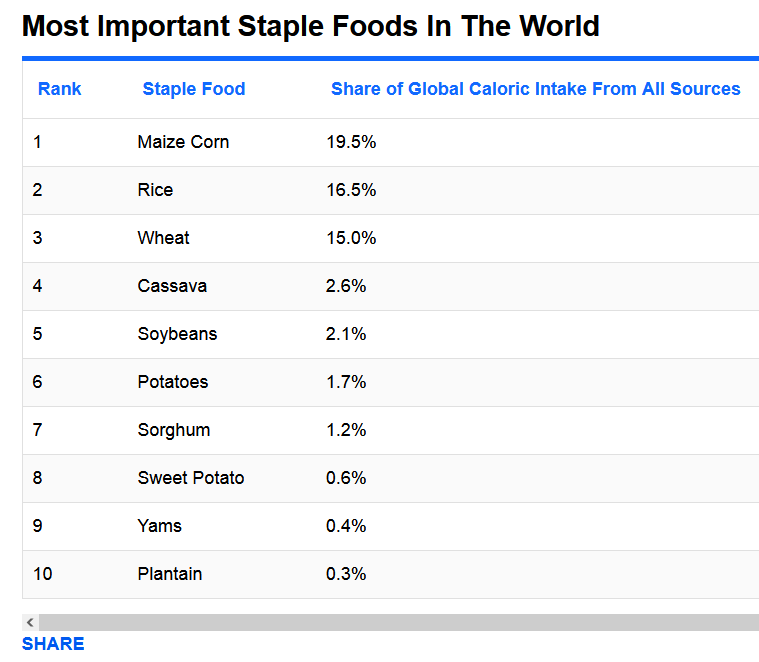
https://www.worldatlas.com/articles/most-important-staple-foods-in-the-world.html
With the exception of soybeans and plantains – they are either grasses or tubers, and they can be farmed without pollinators. It shall be noted that cultivated varieties of bananas and plantains do not usually need pollinators, but the wild and heirloom varieties usually need pollinators.
In any case – stop overreacting. We’re not sinking just yet.